Are Crunches Bad? A Coach’s Honest Answer for Women Over 40
Ask five coaches whether crunches are bad, and you'll get six opinions and at least one raised voice. We know, because...
Last updated: February 5, 2026
We live in an age where everyone searches, wants, and begs for it.
What is it?
The answer to low energy levels and nagging inflammation and bloating.
The key to finally looking in the mirror and feeling confident in the person looking back at him or her.
Nearly everyone is looking for the secret to fat loss.
Do I have it?
No.
But don’t let that keep you from reading further!
I wish I was writing this blog to tell you I did, but the reality is that there is SO MUCH that goes into fat loss that there isn’t ONE THING that guarantees fat loss for everyone.
But there is one thing that everyone hoping to lose fat and change their body composition needs to make a part of their routine.
That thing is tracking or food logging.
You know the saying, “It’s 10% what you do in the gym, and 90% what you do in the kitchen.”
Or whatever numbers you may have heard before.
The truth is that 100% of what you do in the kitchen determines your fat loss and body composition results because you cannot outrun or outwork a poor diet.
As a nutrition coach, I ask all of my clients to track food because it’s THAT important.
For most, it’s completely new to him or her, so there are ALWAYS follow-up questions.
Because of that, I wanted to give those of you who are on the fence about tracking a little deeper insight, a better understanding, and a look as to how you can make this fit into your lifestyle.
Here are the most frequently asked questions about tracking, and my answers to hopefully help you develop a little clarity on tracking.
Tracking your food doesn’t guarantee you fat loss, but there is so much you can get out of it.
There are two major insights you get from tracking.
Awareness
It brings awareness to your eating habits by helping you to realize how much you are eating and your food tendencies.
It allows you to see things like:
Education
Tracking teaches you the ins and outs of the foods you’re eating.
You grow to learn the calorie and macronutrient breakdown of food, which can really benefit you as you eat untracked meals.
Beyond numbers, it educates you on your body’s response to specific foods.
If I NEVER tracked my food, I would have never found that brown rice and oats are so hard on my gut.
There is so much awareness and education that comes from tracking, as the beginning is quite the eye opener.
I have yet to meet a client, regardless the fat loss results, who has said tracking taught him or her nothing.
It may not guarantee fat loss, but I do guarantee that it will teach you something.
It depends.
A good coach’s favorite answer.
It depends on what your ultimate goal is.
Are you looking to compete or perform in a sport?
Do you plan to compete using your aesthetics, like bodybuilding or figure competitions?
Do you have very specific health goals?
These may all be scenarios where you are tracking for the majority of the year.
Typically, for most fat loss clients, it is advised to diligently track until you have reached your goal weight, been brought back to maintenance calories, and we have worked together on building the skills for intuitive eating.
Now, there are plenty of people who reach their goal and are living at maintenance calories, but still prefer to consistently track for accountability purposes. These individuals still have untracked meals and days throughout the year because we work together to find ways track without interfering with everyday life.
It depends.
I hate to give the same answer, but the reality is that it really does depend on what
works for you.
Here are 3 ways my clients track food:
Pros
Cons
Pros
Cons
Pros
Cons
Tracking has been given a bad rap, as it has grown to be thought of as something that can only be done on confusing phone apps.
Tracking doesn’t have to be done on confusing phone apps because there are alternatives.
If you’re dead set on using an app, but aren’t super tech-savvy, then click HERE and I’ll send you a walk-through explanation video.
The point is to make tracking fit to your lifestyle, so play around and choose the method most suitable for you!
Assuming you’ve picked the method that works best for you, now it’s time to determine where or what to actually track first.
Some will say to just jump right in and track everything that goes in your mouth, but if this is a foreign concept to you, then I encourage you to start even smaller.
Pick one meal and commit to tracking it everyday for one week.
Then, if you think you’re ready to handle tracking every meal, great, go for it! But if you think you still need to take it slower, gradually add in another meal each week until you’re successfully tracking every meal.
Besides which meals to start tracking, there’s also the question as to WHAT it is you will be tracking – calories, macronutrients, or micronutrients?
Well, because calories are most important, that’s where we’re going to start.
Track the total number of calories of each meal.
Then, start tracking protein.
Then, fats.
Then, carbs.
Finally, micronutrients.
Just as with your means for tracking, it’s about what works for you and your lifestyle, so start small and gradually work to add these into your daily habits and routines.
You know the saying, “eyes too big for my stomach?”
That is a major sign as to why weighing or measuring is important.
When it comes to food, our eyes are terrible judges of size.
Take a look at these two examples.


Sure, the picture may not look like THAT big of a deal, but in reality, it’s nearly two times the portion size.
That means nearly two times the calories!
If you eyeball every ingredient in a day, that could mean nearly two times the calories.
That could be the difference in losing or gaining weight!
Eyeballing is a big deal!
Measuring is like tracking.
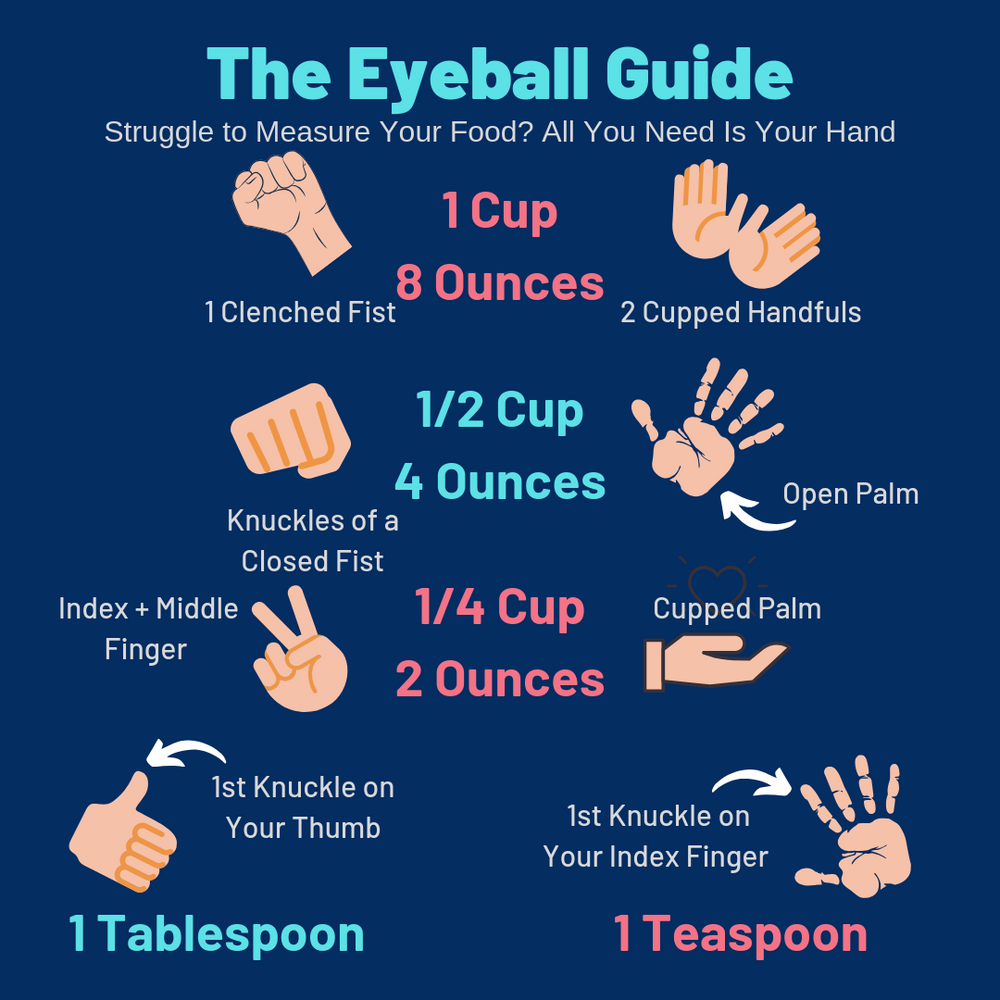
Until you reach your goal weight or body composition, it’s pretty important to stay true to measuring; therefore, once you transition into intuitive eating, you know what 1 cup of rice or 4 ounces of chicken actually looks like.
Think of it as sharpening your vision for when you eat out, so while it may seem like work now, you’re just improving your ability to estimate in the future.
Now, no mater where you’re at in your journey, screenshot this Eyeball Guide to keep with you for when you are out to eat and unable to measure. Unlike measuring cups, your hands always go with you, so you always have at least one tool for measuring!
Think about when you learned to ride a bike.
You didn’t get it right away, right?
No, you had to spend time learning how!
Same goes for tracking.
I’d be lying if I said you will just zip through it off the bat because it does take time, but if you put the time in and work past the ‘newness,’ it gets easier and you see results!
Here are my keys to make tracking go faster early on:
Even utilizing these tips will take some time in the beginning, so be patient with yourself as you work to add this new skill and eventually your daily log will be completed in no time!
Nothing about health and tracking is meant to be perfect; it is entirely about
consistently doing your best.
I tell all of my clients with fat loss goals that the goal is to eat 90 percent clean 100 percent of the time, which leaves 10 percent for meals out, social events, and your favorite foods.
Let’s break that down into your day-to-day life.
If you eat 5 meals per day all 7 days of the week, you’re eating 35 meals in one week. In the 90 percent rule, that means 31 or 32 meals should be clean, which leaves 3 to 4 meals for social gatherings.
I encourage you to take a look at your week, and purposefully identify 3 to 4 “less than perfect” meals. Do your best throughout the week, and each time one of those meals comes up on your calendar, don’t stress and know that you have some flexibility.
If you want to know more about the specifics of eating out, shoot me a message, and I’ll help you break down your next social gathering!
Too often, people believe that tracking means food gets boring.
Good news!
That’s not true!
Tracking just means you keep track of the creativity to your recipes and make modifications to bring you closer to your goals!
Take a few minutes to add your favorite recipes. Then each week add the recipes you’re planning for the week, and modify to fit your plan for the week.
Now, if you struggle with meal prep creativity, then head on over to and read about tips to free yourself of food boredom in ‘Are You Ready to be a Meal Prep Master?’
If you’re ready to move into macro tracking, CONGRATULATIONS! That’s a huge step, and can really enhance your results.
I have three recommendations for you:
Last updated: February 5, 2026

and get
With our Complete Performance Referral Program, you get one month free when you refer a friend! So you get to spend time with your buddy AND save money.
Subscribe to Our Newsletter!
Ask five coaches whether crunches are bad, and you'll get six opinions and at least one raised voice. We know, because...
Twenty-one days. If you finished the Big A$$ Salad Challenge - you did something real. Not because a salad a day is...
One week from Saturday, October 10th, Complete Performance is hosting the most ambitious community health event we...
Here is something I want to say to everyone who is currently on Day 8, 9, or 10 of the Big A$$ Salad Challenge: You...
Looking for more tips & tricks?


Run Faster & Jump Higher!

Try our very own 3x3 Program!

with The Core Training Hierarchy!
Get Started by Booking a