Are Crunches Bad? A Coach’s Honest Answer for Women Over 40
Ask five coaches whether crunches are bad, and you'll get six opinions and at least one raised voice. We know, because...
Last updated: December 16, 2020
Did you know that gravity pulls down harder on you as you age?
Okay, so maybe it isn’t REALLY gravity that causes certain areas (boobs, butts, cheeks, etc.) to sag…
Regardless the cause, we all drag the sag.
We dread it so much that people will pay THOUSANDS for cosmetic work.
And for what?
A quick fix?
There’s always more to be done and a need for maintenance, so it quickly becomes more, more, and more and before you know it you look like Kim Kardashian.
What if there was a way to naturally give you a lift?
Oh, but there is and it’s cheaper too!
This can all be done with some work to your posterior chain.
Unfortunately, the reason your butt begins to sag is because the posterior chain is so neglected in training.
We love our squats, lunges, push-ups, and core work. Don’t get me wrong, they’re great, but they neglect some of the biggest muscles in the body (found in the posterior chain).
All of my clients do A LOT of work on the posterior chain, and I believe you should too.
First, you need to know what it is then we’ll breakdown the different areas of focus so you can see the best results in strength AND aesthetics.
The posterior chain is the group of muscles along the backside of your body. Believe it or not, the posterior chain extends from the back of the neck all the way down to your feet.
These are some of the biggest muscles in your body, and they significantly contribute to your postural and functional strength.
Examples of these muscles include your hamstrings, gluteus maximus, erector spinae, trapezius, latissimus dorsi, and deltoids.
Functionally, these are involved in a number of pulling exercises like deadlifts, good mornings, rows, and pull ups.
These days there aren’t too many people who don’t know where the glutes are located.
That’s simply because we fall into either 1 of 2 categories:
Now because the glutes have become such a big area of focus there is A LOT of information out there on them, BUT not all of it is good…
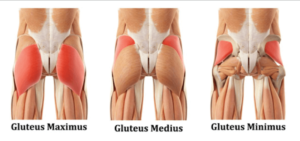
Let’s first make sure you know WHERE the glutes are before we get into what they do and how to work them.
Simply put, the glutes are your butt cheeks, seat, rump, derriere, fanny, wide load, or whatever else you may refer to it as.
There are 3 parts to the glute:
Here are 9 things you need to know about your glutes:
One great part about the glutes becoming such a popular exercise to train is that there are SO MANY exercises to hit them now. Because of all the exercises, coaches have broken down the exercises into different categories. Here are the 3 categories I use for my in-person and online clients.
These are the Big Dog lifts. The ones that will give you the most bang for your buck.
The Big Movers have a greater degree of complexity, lead to a greater amount of muscular breakdown, and require a larger amount of time for recovery (3 to 4 days).
Training these movements too often can really hurt your progress and your body; however, training them properly can really offer up some results in your backside.
Here are some of my favorite Big Movers:
Now, you look at that list of exercises and you might have 2 to 4 in your current training program on a single day. Any more than that and you’re probably putting yourself at a pretty big risk for damage.
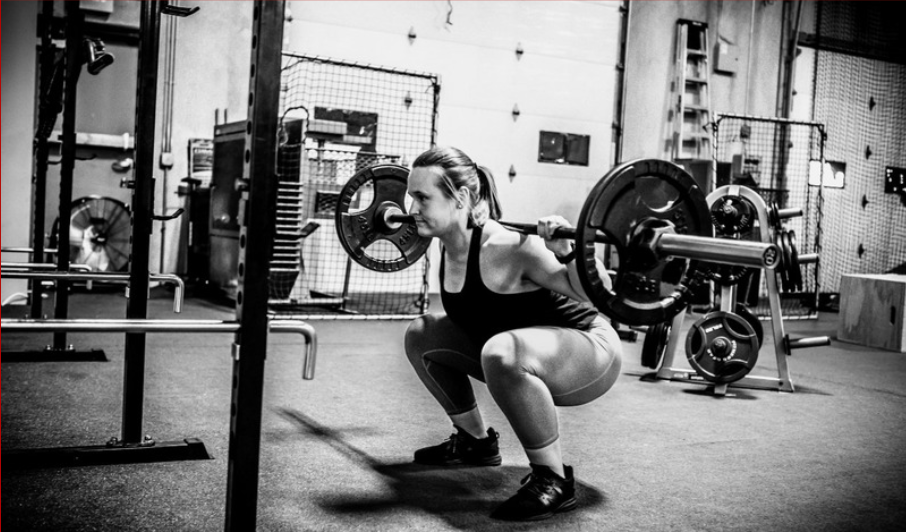
For my clients, I prefer to start their training program off with a heavy squat variation (Barbell Back Squat or Double DB Squat) with a single leg exercise (Bulgarian Split Squats or Reverse Lunges) later in the workout. On a separate day, I like a more “Pull” focused approach. This day features a moderate to heavy set of deadlifts (Conventional, Sumo, or DB Deadlifts) with another single leg, probably more quad dominant movement (Bulgarian Split Squats).
In programming, here is the typical structure I like to follow:
*Reps determined based on a client’s goals.
These are the exercises I like to consider to be a bit more joint friendly. There’s less weight involved and in some, a shorter range of motion.
The decreased intensity of these lifts allows you to recover faster and more frequently train them.
Here are my most often programmed Assistance Exercises
When it comes to programming, I prefer to select 1 to 2 Assistance Exercises per lower body training day. Building off the example above, the first training day might include a Barbell Hip Thrust and Back Extension for more posterior chain focus. The second day might feature Step Ups or Pull Throughs for further practice of the hip hinge motion.
Here’s my typical Assistance Exercise programming structure:
These are the silent killers. The one’s you watch your coach demonstrate or see someone else doing in the gym and think “That’s it?” But then you give them a shot and THEY BURN.
These exercises don’t require a great deal of weight, and are primarily kept to small weights, bands, tempos, or body weight styles. They’re great for adding a great pump and stressing the metabolism; however, they’re easy to recover from. The shorter recovery window allows you to train these more frequently.
Here are my favorite burners:
These are the exercises I program into the warmup for my clients as well as at the end to “finish off” the glutes. They’re great for pre-fatiguing the muscles for your Big Movers and Accessory Exercises, and they’re great for stimulating glute growth because of the frequency and volume.
Here’s the programming structure:
Before we move a bit further down into your posterior chain, I want to leave you with some of my top coaching cues for glute specific training:
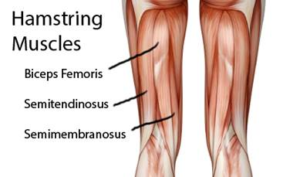
If you’re serious about giving your booty a real and natural lift, then you need to work the hamstrings. These are the muscles right below the glutes and hips on the back of the legs, and the stronger they are, the more they’re going to push your glutes up.
Hamstrings are pretty often forgotten. They aren’t the most aesthetically, and how often do you look at that back of your legs?
The great part about hamstring work is that there’s A TON of overlap with your glutes, so as long as you’re training your glutes, you’re really killing two bird with one stone.
BUT I won’t deny that it’s important to specifically train your hamstrings too.
Hamstring work can be broken down into two hinge categories.
The hamstring attaches within the hip, so any hip hinge variation is going to strengthen the origin and belly of the hamstring.
When it comes to programming, similar rules apply as to the Big Movers.
Now, the one difference between Hip Hinge Movements and the Big Movers is that the hamstrings fatigue faster than the glutes. Therefore, repetitive heavy hip hinge work can leave your hamstrings with a ton of soreness and a great deal of low back fatigue or tightness.
But here’s what programming typically looks like:
*Reps determined based on a client’s goals.
These can be more of your “bro” exercises, but that doesn’t mean you should skip them.
Leg curl movements are important for targeting the origin or the part of your hamstring closest to your knee.
Here are some of my favorite exercise:
Programming for Leg Curl movements is more comparable to programming for the Assistance Exercises.
Here are my general rules of thumb:
Just like with the glute, there are few coaching cues that I find beneficial to my clients.
We hit the glutes directly.
We hit the hamstrings (the muscles right below) to help push the glutes up.
Now, we need to talk about the muscles that can help to PULL your glutes up. That comes in work of the back.
Beyond the appearance of your butt, the strength of your back is the secret to your
upper body strength.
Unfortunately, much like the hamstrings, how often do you look at your back?
Not until you look back at a picture or try to fit into a dress or outfit revealing your back.
BUT how often do you feel back stiffness, tightness, or pain?
Everyone loves their pressing exercises, their curls, and their triceps because they’re the muscle groups we see and the exercises we know how to perform.
However, neglect of the opposite side can hurt your overall appearance AND leave you in quite a bit of discomfort or pain.
Typically, I program TWICE as much pulling or back exercises as pushing exercises. Even more, I program some variation of an upper body or back pull into every lower body training session.
In my experience, there are two big reasons people don’t train their back enough.
The back is HUGE and made up of so many muscles, but here are some of the major players for back work:
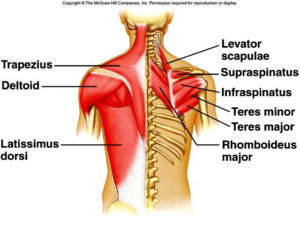
Now that you know what they are, we know it’s not a lack of knowledge on the muscles, BUT we still need to solve the HOW.
For my clients, I break back work down into three categories because the back has SO MANY functions there are a variety of exercises and styles for training that are necessary to provide you best results.
These are the exercises where you’ll be asked to move some weight. If you’re utilizing Big Mover exercises, Hip Hinge exercises, or any exercise that requires to lift or hold a significant load, then you need Back Strengthening exercises.
These are the ones to help you withstand a great deal of force and with proper programming can help you to become stronger in your additional lifts.
Here are my favorite Back Strength Exercises:
With my clients, these exercises come almost immediately following Big Mover and/or Hip Hinge exercises. Because they are targeted at building strength, my goal is to hit these muscles while muscles are still relatively fresh.
Here are my recommendations for programming:
If you have strength or physique goals, training for back strength is necessary, for without challenging the back to build strength, you are way more likely to face low back fatigue, tightness, and pain.
These are exercises where weight or resistance is likely still used, BUT the emphasis shifts away from adding weight each week or set and towards the movement pattern.
Personally, I think of these exercises as big time contributors to strength in your everyday activities. These exercises are largely focused on postural muscles and their activation.
Here are my top Back Volume Exercises:
These are not the toughest or most bada** looking exercises, but they are GREAT for leaning out your back and helping you to reach your aesthetic goals.
These are secondary exercises programmed after the Big Movers and Hip Hinges, and are most often paired with Assistance or Knee Hinge Exercises.
Here’s what I suggest for programming:
All my clients seem to have a love-hate relationship with these….
These are NOT the sexiest exercises.
They’re the exercises that look pretty easy, but leave a killer burn; however, they’re also the ones that are pretty easy to just skip over.
YOU CANNOT SKIP OVER THESE.
They do so much for your posture, day-to-day activities, and overall health that neglect can leave you with major tightness and pain.
Here are my favorited ones:
None of these looks all that intimidating or intense, but improper programming can really cause some damage. Take a look at what I recommend for my clients.
Don’t let these little guys fool you! They make a big difference not only in how you feel during your bigger exercises but in how you sit in your chair or walk around your house.
My hope is that you get it now – the posterior chain is important.
My hope is that you know squats, machines, and cardio cannot alone give that booty a little lift.
Training your posterior chain can help your fat loss goals.
It can help you look, feel, and BE lean and strong.
It can help you be more functional, active, and pain-free during your day.
There are endless benefits to posterior chain work, so let’s get to work!
Jordan Davies is the Co-Owner of Complete Performance. Jordan has her B.S. in Exercise Science and Psychology, and her M.A. in Holistic Health Studies. She is a CSCS certified strength and conditioning coach, and a PN-1 and NCI-1 certified nutrition coach. She loves to study how the human body needs to be moved and nourished and making that fit to your unique lifestyle. Click Here Now to Apply for Coaching with Jordan.
Last updated: December 16, 2020

and get
With our Complete Performance Referral Program, you get one month free when you refer a friend! So you get to spend time with your buddy AND save money.
Subscribe to Our Newsletter!
Ask five coaches whether crunches are bad, and you'll get six opinions and at least one raised voice. We know, because...
Twenty-one days. If you finished the Big A$$ Salad Challenge - you did something real. Not because a salad a day is...
One week from Saturday, October 10th, Complete Performance is hosting the most ambitious community health event we...
Here is something I want to say to everyone who is currently on Day 8, 9, or 10 of the Big A$$ Salad Challenge: You...
Looking for more tips & tricks?


Run Faster & Jump Higher!

Try our very own 3x3 Program!

with The Core Training Hierarchy!
Get Started by Booking a